
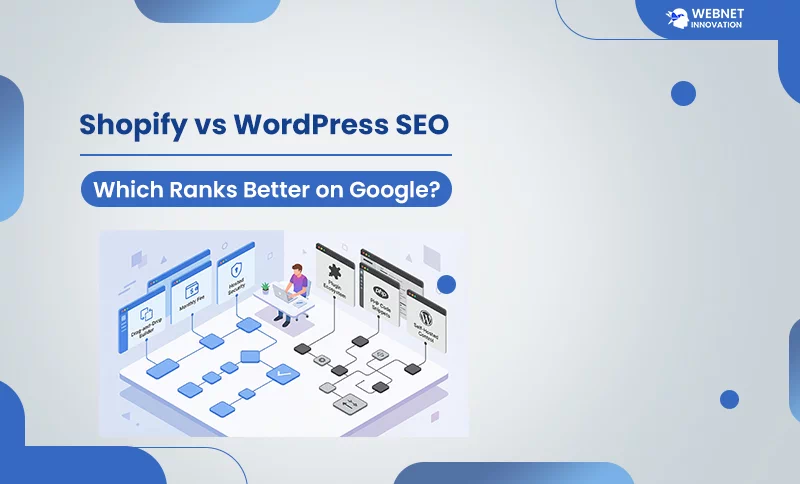
When discussing the launch of your online store with those close to you, a common sentiment often arises: ‘If your store isn’t on the first page of Google, it practically doesn’t exist. But when you start building your digital store, the biggest question you’ll face is: Shopify or WordPress SEO?
From an SEO Service Agency perspective, this debate has been going on for years. Over the past decade, many businesses have lost millions in traffic and rankings by choosing the wrong platform. They think that simply switching platforms will rank their website on Google. But the reality is that Google doesn’t have a “favorite” platform and doesn’t care whether you pay a $29 monthly fee or manage your own servers. They only want three things: excellent speed, clean code, and a great user experience.
In this article, we’ll explore the “hard truth” of Shopify vs. WordPress SEO that marketing companies often don’t tell you.
1. Out-of-the-box: Which is the best Shopify or WooCommerce SEO?
When you start a new store, you want to have basic SEO in place. The two platforms have very different philosophies here.
Shopify: Set it and forget it
Shopify is designed for entrepreneurs who don’t want to get involved in coding. You could call it the “iPhone” of e-commerce.
- Automatic features: It comes with an SSL certificate built in. Your website’s sitemap.xml and robots.txt both files are automatically handled by the system.
- The power of a CDN: Shopify has its own global Content Delivery Network (CDN). It means your website data, like photos and files are stored on servers around the world. This feature makes your site load faster in every country.
- Meta Updation: You can easily update the page meta title and description.
Big Challenge: Shopify is a managed and closed ecosystem. The biggest problem for SEO professionals is the URL structure. This forces your products to always appear after /products/ and pages after /pages/. If you want a short and clean URL structure (like myshop.com/blue-widget), that’s impossible in Shopify. This “silo structure” sometimes hinders complex website architecture.
WordPress: Unlimited Open Source Power
WordPress is a powerful open-source tool to build a flexible website. It is the best e-commerce website builder for those planning to launch a Online Store at reasonable price.
It is a Open Source platform that provide a power to host your website on your local system and develop the website at 0 cost. When you feel your website is ready to launch, select your domain and hosting from the best hosting provider. You can transfer the local website to the live server. You can live your simple website or online store with the help of WordPress.
WordPress is a powerful content management system, so you don’t need to learn high level coding. You can easily manage your website SEO:
- Unlimited Free Plugins: Here, you have access to tools like Yoast SEO or Rank Math. These plugins tell you your keyword density and readability while you’re writing your content.
- Full Control: You can change every single character on your website. Whether you want the website URL to be /shop/my-product or just domain.com/my-product—it’s entirely up to you.
- Full Customization: If you know basic coding like HTML, CSS, and PHP, you have great power in your hands.
2. Technical SEO: Importance of Schema and Coding
Search engines not only read the text but also the code of the website. This is exactly where technical SEO plays a role.
Schema Markup
When you search for a product on Google, and you see star rating, price, and ‘In Stock’ written in the search results, it is because of Schema Markup.
- WordPress: Adding schema markup is a breeze with plugins like Rank Math or Yoast. You can even add custom schemas (Video Schema, FAQ Schema).
- Shopify: This is where you need to get a good ‘SEO-ready’ theme. Unless you select a theme that includes this feature, you are either going to have to learn coding (Liquid) or install a resource-consuming app.
Difference in Programming Language (Liquid vs PHP/MySQL)
- Shopify uses its own language, Liquid. It’s very secure and clean, but it doesn’t give you ‘direct server access.’
- WordPress is based on the old and reliable PHP and MySQL. If you’re a developer or want to integrate your site with modern languages like React or Python (headless commerce), WooCommerce offers much more flexibility.
3. Speed Performance: Is your store ‘loading’ or ‘slowing down’?
Since Google’s Core Web Vitals update, speed has moved beyond being a mere feature; it is a fundamental aspect of ranking. A 1-second delay reduces conversions by 7%.
Is Shopify Website Load Fast?
Shopify is a Hosted Platform, which means its server is specially tuned for an e-commerce store.
- Advantage: You don’t have to worry about server optimization.
- Disadvantage: If you use too many ‘apps’ (like ‘Spin the Wheel’ or ‘Live Chat’) in your site, your website’s loading speed will slow down. Since you can’t change server settings, you’ll feel helpless to fix it.
Is WordPress Website Load Fast?
WordPress website speed depends entirely on your hosting and how your WordPress website is customized. In simple word limited plugin usage and a fast server make a website faster.
- Cheap Hosting Trap: Don’t be fooled by low-cost hosting services; this is simply a trap to increase revenue.
- Choose Best Hosting: If you use hosting like DigitalOcean, AWS or Google Cloud, as well as plugins like Litespeed Cache, your WordPress Store can run up to 2x faster than Shopify.

4. Content Marketing: The Real Engine of Ranking
The purpose of SEO is not only to increase keyword rankings but also to help users reach their solution.
Power of Blogging
There is no doubt that WordPress (WooCommerce) is the best blogging platform in the world. 60% of blogger using WordPress for blogging and earn passive income.
- Topic Clusters: You can easily create pillar pages and connect them with internal links. Google loves this structure.
- Media Management: It’s very easy to manage photos, videos, and infographics within a blog in WordPress.
Shopify Limited For Blogging
Shopify’s blog section is “temporary.” Category management is terrible, and you can’t easily add product widgets to your blog (unless you purchase an app). If most of your website traffic comes from a blog, Shopify will disappoint you.
5. Cost Analysis (The Hidden SEO Costs)
There is no free platform to create an SEO website; you have to invest a little bit of money from your pocket. WordPress is an open-source software that provides the power to develop your website on your local system, not a live server. Shopify will charge when you start building your online store.
| Cost | Shopify | WooCommerce |
| Platform Fee | $29 – $299/month | $0 |
| Hosting | Integrated | $10 – $100/month (Best Hosting) |
| SEO Tools | $20 – $50/ month (Apps) | $0 – $100/year (Plugins) |
| Maintainance | $0 | $50 – $200/ month Developer/Security) |
From an SEO perspective: With Shopify, your money is spent on apps. With WooCommerce, you can invest that money in improving your site speed and content quality.
6. Mobile-First Indexing: For Better Sales
Did you know that 75% of users are searching for products right from their smartphones? Google prioritizes mobile-friendliness above all else. If your site doesn’t perform well on mobile, your rankings will inevitably drop.
- Shopify: Almost all of its themes are mobile-responsive. Its checkout page is considered one of the fastest in the world.
- WooCommerce: You’ll need to choose a theme carefully. Heavy themes can be slow on mobile. Lightweight themes like Astra or GeneratePress are best for SEO.
7. E-commerce Security and Google’s Trust Factor
Google gives ranking priority to websites that maintain high security standards, such as having an SSL certificate.
- Shopify: It complies with PCI standards. You don’t have to worry about hacking or data theft. Google considers it a “trusted brand.”
- WooCommerce: Security is your responsibility. If your plugins are outdated, your website could be hacked. Once a website is hacked, Google flags it as “This site may be harmful,” which can ruin years of SEO work in minutes.
Conclusion: Choosing the right platform and the key to success
The bottom line of this long-running SEO debate between Shopify or WooCommerce SEO is that neither platform is a “magic solution.” Shopify is a boon for those who want to start a business quickly, avoid technical complexities, and are satisfied with basic SEO. WooCommerce, on the other hand, is for strategists who want control over every pixel and code of a website so they can manipulate Google’s algorithms.
Remember, Google never ranks your website software; it ranks the value of your content and user trust. Whichever platform you go for, the user-friendly Shopify or the extremely powerful WooCommerce, your success will be reliant on how effectively you can address the needs of your customers. When you’ve set up your tech stuff, get busy with engaging content, better speed, and a mobile-friendly experience. There’s no need to keep delaying it. Make your platform choice, make it yours, and get going with your digital shop.