
Paid traffic to your homepage is like hosting a party and forgetting to give guests directions to the room. When visitors arrive, they are confused and leave before the event starts.
If you are serious about landing page conversion rate optimization, here is the one truth most marketers learn the hard way — your audience does not want to explore your website. They want a solution to a specific problem, and they want it fast.
Whether you are a developer building an HTML landing page from scratch or a marketer trying to design a landing page for Google Ads, choosing the wrong structure is the fastest way to destroy your return on investment before the campaign even gets going.
The Landing Page vs Website Difference: Why You Are Losing Money
Before getting into the types, it helps to understand the landing page vs website difference clearly — because most businesses blur this line and pay for it with poor conversion rates.
A website is a buffet. It has a little bit of everything — your story, your blog, your services, your contact page. A landing page just like Michelin-star steakhouse. There is one goal, one path and one specific outcome expected from every visitor who walks through the door.
A landing page for Google Ads works so well precisely because it removes the noise. No navigation menus pulling people away, no “About Us” links, no blog widgets competing for attention. Just a focused environment built around one single action.
That focus is what drives conversions. And conversions are what make ad spend worth it.
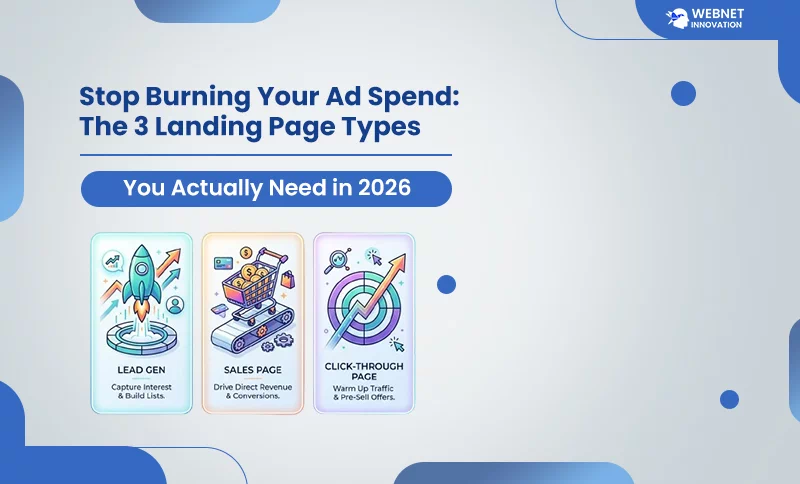
1. The Lead Generation Landing Page — Build Your List the Right Way
Let us discuss the ever-recurring debate in marketing conversations about the squeeze page vs landing page.
A squeeze page is a specific type of lead generation landing page. Its only job is to collect an email address. Nothing else. No distractions, no secondary offers — just a compelling reason to hand over contact details and a simple form to do it.
In 2026, everyone is even more concerned with keeping their personal data safe than ever before. Just asking “subscribe to our newsletter” is no longer a good sales strategy. You need a high-value lead magnet — something genuinely useful that makes the exchange feel worthwhile.
When does a lead generation landing page make sense:
- Building an email list around a React or Python development course
- Offering a free SEO audit tool to attract potential clients
- Giving away a whitepaper on AI implementation or frontend web API development
- Running a webinar registration campaign through Google Ads
Landing page best practices for lead generation:
- Keep the form as short as possible — every extra field added drops conversion rate by roughly 10 percent
- If a phone number is not absolutely necessary, do not ask for it
- The headline should directly reflect the ad copy the visitor clicked on
- Make sure the form is placed above the fold so that the visitors will not need to scroll down to find it.
The simpler the ask, the higher the conversion. That is not a theory — it is what the data consistently shows.
2. The Click-Through Landing Page — The Warm-Up Your Sales Process Needs
This is the most underrated format in digital marketing. A click-through landing page sits between an ad and the final purchase page, and it does something a product page alone cannot do — it warms the visitor up before asking for money.
Why not send paid traffic straight to the checkout? Because most people are not ready to buy the second they click an ad. They need context. They need to understand the benefit, see social proof, and feel confident before moving forward. The click-through page handles all of that before pushing them to the actual sales landing page.
This format is very suitable for ecommerce and SaaS products especially when the price requires some kind of justification before the purchase button is enabled.
How to create a high-converting click-through landing page?
- Lead with one clear, benefit-driven headline that matches the ad they clicked
- Use before-and-after scenarios from real product landing page examples to show transformation
- Include testimonials and social proof above the fold — not buried at the bottom
- Feature one large, impossible-to-miss CTA button that drives to the next step
- Make sure the messaging on the page matches the Google Ads copy word for word
That last point matters more than most people realize. Consistency between ad copy and landing page copy is not just good for the visitor experience — it directly affects Google’s Quality Score, which determines how much is paid per click.
3. The Long-Form Sales Landing Page — For High-Ticket Offers That Need More Convincing
Short landing pages are suitable for low-risk decisions. However, if the offer is with a high price tag say a $2000 coding bootcamp, a complicated enterprise PHP & MySQL software package or a high-end consulting service a short page will not be sufficient.
A comprehensive sales landing page is an excellent tool to rebut all potential objections of the visitor even before their thoughts raise them. It is mind-opening that the page manages to transform the reader from unconviced to persuaded through a well-ordered story telling the problem, the solution, the proof, and the offer.
That’s why narrative gets its rightful place in marketing. It should outline the issue the visitor is facing and deliver the solution in simple and direct language. In addition, stressing one through one example, one case study, and one result achieved by real people should be the strongest point of the page in winning over visitors.
What every long-form sales page needs to include:
- A powerful headline that speaks directly to the visitor’s biggest frustration
- A problem section that makes the reader feel genuinely understood
- A clear explanation of the solution and why it works differently from alternatives
- Multiple layers of social proof — written testimonials, video reviews, and real numbers
- An FAQ section that handles the most common objections directly
- A guarantee that removes the risk from the decision
- A strong closing CTA that creates urgency without feeling manipulative
The length of this page should be determined by how many objections need to be addressed — not by an arbitrary word count. Some high-ticket offers need 3,000 words. Some need 6,000. Write until the objections run out.
How to Design a Landing Page for Google Ads — The Mistake That Kills Quality Score
Among paid advertising, this may be the most frequent and costly mistake. A business could invest thousands in a Google Ads campaign and then direct all that traffic to a page not even including the keyword the visitor had searched for.
If a visitor searches for “frontend web API development services” and clicks on an advertisement, the landing page headline has to mirror that very phrase. It’s not simply something close to that it is that very intent.
However, matching the visitor’s expectations is only one side of the story even though it is really important. It is also about Google’s Quality Score. Google recognizes landing pages that are highly relevant to the search intent of the ad and gives them a higher score. A better Quality Score entails lower click costs for the same ad placement. Cheaper ads with the same visitor count imply a higher ROI without altering the budget.
Landing page SEO best practices for Google Ads traffic:
- Match the primary keyword from the ad in the H1 heading of the landing page
- Include the keyword naturally in the first paragraph of the page
- Make sure page load speed is under two seconds — Google measures this and users abandon anything slower
- Optimize fully for mobile — in 2026 most paid traffic arrives on a smartphone, not a desktop
- Use structured data markup to help Google understand the page content clearly
Key Takeaways for Landing Page Strategy in 2026
Getting landing pages right comes down to understanding a few principles that do not change regardless of the industry or the offer:
- Match the page type to the traffic temperature — cold traffic arriving from a broad awareness ad needs education before being asked to buy. Warm traffic that already knows the brand needs less convincing and converts better on a focused squeeze page
- Speed is not optional — whether using WordPress or a custom HTML landing page, anything that takes more than two seconds to load will cost conversions before the page even has a chance to sell
- Mobile is not an option – rather, the norm, if a landing page doesn’t fit very well and work to entertain the user on his / her smartphone screen, the ads leading to it end up burning the budget
- AI personalizing works – but never lose the human touch, it is a good thing to use AI to match the copy with the user’s search intent. It is not good to let the page sound robotic and generic.
Which Landing Page Type Do You Actually Need?
The answer depends entirely on the goal.
Creating an email list? Create a lead generation squeeze page offering a valuable piece of content (lead magnet) and featuring a very short form. Marketing a physical product or a simple SaaS subscription? Employ a click-through landing page to introduce visitors and guide them to the checkout.
Offer a transformation, a course, or a top-notch service? Make the landing page a long one and tackle all the visitor’s potential objections.
One of the errors most companies commit is trying to have a single page perform all three functions simultaneously. Such a method satisfies none of the tasks. One page, one objective, one target group, one clear call-to-action, that is the formula that actually yields results.
Final Thought
A landing page is a 24/7 salesperson working on behalf of every ad campaign running. If a salesperson who mumbled, got easily distracted, and forgot to mention the product would not be hired, a landing page that does the same should not be built.
Get specific about the offer. Get simple with the design. Get the conversion rate moving in the right direction.
The ad spend will thank you for it.