
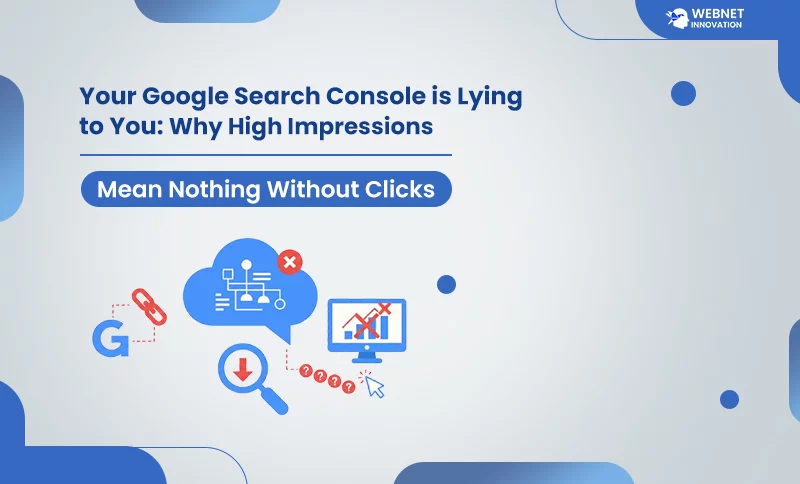
Do you know about the digital illusion? If your answer is no so you are learning like a turtle. Now these days, “Visibility has become a Vanity Metric for a website owner.”
Imagine you’ve spent months planning a lavish gallery opening. You’ve hired the best curator the lighting is museum-grade, and you’ve plastered tens of thousands of bright, neon flyers across the city.
Opening night arrives. You are looking from the window and see a gigantic crowd forming on the sidewalk. They are peering through the glass. They are pointing at the frames. They are reading the plaque on the door.
And then, every single person walks away without coming inside.
In the world of SEO, this is the “Ghost Impression” phenomenon. You log into Google Search Console (GSC), and that beautiful purple line (Impressions) is climbing like an Olympic sprinter. You feel like a genius—the algorithm has finally “found” you. But then you look at the orange line (Clicks). It’s been dropped flat at the bottom of the graph, just like a balloon that has lost its air.
If your purple line is soaring while your orange line is stuck in the mud, you don’t just have a ranking problem. You have a psychological conversion crisis. You are getting more exposure than your competitors, yet you are failing to convince a single human being that your link is worth their precious three seconds of attention.
In this blog, we are going to dissect the anatomy of a click. We will explore why users “window shop” your results and how you can transform your search presence from a “billboard no one notices” into a “destination everyone craves.”
I. The Neuroscience of the Search Result: The 2-Second Filter
Before we touch a single line of code, we must understand the human on the other side of the glass. A Google search isn’t like scrolling through Instagram. When someone Googles something, they are in “Problem-Solving Mode.” They have a “burning itch,” and they are looking for the “scratch.”
The F-Shaped Scanning Pattern
Eye-tracking studies consistently show that users do not read search results word-for-word, but instead quickly scan them in predictable patterns to minimize effort. While seeing all the result list their eyes move in an F-shaped pattern: first, they move over the first result, then a little over the second result, and finally move vertically down the left side of the page.
When selecting their result, people actually want their choices to satisfy three innate questions within 1.8 seconds:
- Relevance: Will this solve my particular problem?
- Authority: Can this person be trusted as an expert in the field?
- Path of Least Resistance: Will I have an easy time reading/using this or is it a sea of text?If you are unable to meet any of these, you become a “Ghost Impression”, a memory which was never even established in the user’s brain.
2. Diagnosis: The 8 Reasons Your “Orange Line” is Flat
1. The “Keyword Stuffing” Suicide (Title Tags)
Your title tag is your digital handshake. Most SEOs write for Google’s bots. They think that if they include the keyword “Best SEO Agency NYC” three times, they’ll win.
While keywords help you rank (the purple line), emotions and benefits get you clicked (the orange line).
- The “Robot” Title: Affordable SEO Services New York – SEO Agency NYC – Best SEO
- The “Human” Title: How to Double Your Traffic: The NYC SEO Agency That Delivers Results
The first title is a list of ingredients. The second title is a finished meal. Users don’t buy ingredients; they buy just outcomes.
The Solution: The “Power Word” Framework
To fix this you need to use psychological triggers in your titles. Since it is now 2026, users are increasingly wary of “AI-generated fluff.” They want human-verified expertise.
- Curiosity: “The Hidden Reason Your Traffic is Stalling…”
- Urgency: “5 SEO Mistakes to Fix Before the Next Core Update.”
- Proof: “[Case Study] How We Boosted Revenue by 40%.”
- Brackets/Parentheses: Research shows that adding [Video Inside] or (With Templates) can increase CTR by 38% because it promises extra value.
2. The “Search Intent” Mismatch (The Silent Killer)
The most common reason is “Search Intent” mismatch for high impressions and low clicks. Google’s ranking algorithm is advanced, but it is not perfect. It could rank your website’s page on an unknown keyword that is slightly related to your content, but doesn’t actually match what the user wants..
Example: The Apple Trap
Imagine you wrote an incredible long-form article titled “The History of the Apple Logo.” You might start ranking for the broad keyword “Apple.”
A user searching on Google for the latest iPhone 17 or looking to buy a MacBook, every time your “History of Apple” article gets an impression. But that user isn’t looking for a history lesson—he wants to buy a Apple company’s product and spend money on it. They see your link, realize it’s an encyclopedia entry, and skip your website’s URL.
The Fix: The GSC Query Audit
You must perform a “Query-to-Content” audit.
- In GSC, click on a specific page that has low CTR.
- Look at the “Queries” driving the most impressions.
- Are they Transactional (Buy…) or Informational (What is…)?
- If the searcher wants to buy and you are trying to teach, you will never get the click. You must either rewrite the page to satisfy the intent or stop trying to rank for that keyword.
3. The “Ghost of Page Two” Syndrome
There is an old, dark joke in the SEO world: “The best place to hide a dead body is on the second page of Google search results.”
If your average position in GSC is 11, 12, or 15, you are essentially on the first page of the second page. Because of Google’s continuous scroll feature (especially on mobile), you are getting “seen” as the user scrolls down, but the probability of a click drops off a cliff after the top 5 results.
- Position 1: ~39.6% CTR
- Position 3: ~10.2% CTR
- Position 10: ~1.1% CTR
- Position 11+: Effectively negligible.
The Fix: The “Striking Distance” Strategy
You don’t need to optimize your entire site at once. Download latest information by filtering your GSC report to show keywords where your average position is between 8 and 15. These are your “Striking Distance” keywords. You only need a little push to rank on the first page.
Once you collect the high impressions keywords with an average position, then adding a few internal links, updating the “Last Modified” date with fresh info, or adding a video, you can nudge these into the Top 3. Moving from #11 to #3 isn’t just a change in rank; it’s a 100x increase in potential traffic.
4. Zero-Click Searches: Google’s Walled Garden
We have to think about the main problem in the GSC. Sometimes, your low CTR is Google’s fault.
Google has changed from being mainly a tool for searching the web (that will direct you to other websites) to a source of answers (that tries not to let you leave Google). Featured Snippets, Knowledge Panels, and AI Overviews are some of the ways Google nowadays gives the answer directly on the search page.
If someone searches on Google search for “What is the capital of France?” and Google displays “PARIS” in giant bold letters, why would they click your blog?
The Fix: The “Teaser” Strategy
To combat zero-click searches, you must stop answering “What” questions and start answering “How” and “Why” questions.
- Fact-based (No Clicks): “When was the Declaration of Independence signed?”
- Strategy-based (High Clicks): “Why the Declaration of Independence almost failed (5 Little-Known Facts).”
Users will click when they realize the answer is too complex, too nuanced, or too visual to be contained in a 40-word Google snippet.
5. Your Meta Description is a Weak Sales Pitch
Your Meta Description is not a ranking factor. Let me repeat that: keywords in your meta description will not help you rank higher.
However, the Meta Description is the only “Ad Copy” you get for free on the SERP.
If you leave it blank, Google will scrape random text from your page, usually something like: “Home. Products. Contact Us. Copyright 2026. All rights reserved.” This looks like a technical error to a user.
The Fix: The 160-Character Ad
Treat your meta description like a Google Ad you’re paying $10 per click for.
- Unique Selling Point (USP): “This guide is based on 10,000 hours of testing.”
- Clear Call to Action (CTA): “Download the free template inside.”
- Benefit-Driven: “Save 10 hours a week with these 3 automation tips.”
6. The Visual Competition: Schema and “Rich” Results
In 2026, the STEP is not just blue links. It’s a bazaar of images, ratings, and prices.
If your competitor has star ratings (Review Schema), price tags (Product Schema), or Recipe Thumbnails, and you just have a plain text link, you look like a black-and-white TV in a 4K world.
The Fix: JSON-LD Schema Markup
Schema is the language you use to “talk” to Google’s AI. By adding Schema, you can win “Rich Results” that take up 2x-3x more physical space on the screen.
- FAQ Schema: Puts drop-down questions under your link, pushing competitors further down.
- Video Schema: By using a video schema browser results display a video thumbnail, which is the ultimate “eye-catcher.”
- Product Schema: It shows “In Stock” and “Price,” which filters out window shoppers and attracts ready-to-buy customers.
7. Brand Recognition (The Trust Gap)
Sometimes, a low CTR is simply a matter of Brand Equity.
If a user searches for “Marketing Tips” and sees two results—one from The New York Times and one from BobsMarketingBlog.net—they will choose the Times 90% of the time, even if Bob is in position #1 and the Times is in position #2. This is “Familiarity Bias.”
The Fix: Build Search Equity
You cannot fix this overnight, but you can fix it through consistent niche authority.
- The “Rule of 7”: Appear on larger sites in your industry so that when users see your name in the SERP, they think, “I’ve heard of these guys before.”
- Guest Posting: Appear on larger sites in your industry so that when users see your name in the SERP, they think, “I’ve heard of these guys before.”
- Consistent Favicon: Ensure your site’s favicon (the little icon next to the URL) is high-contrast and recognizable.
8. The Mobile Failure: Speed and Truncation
In 2026, over 70% traffic comes from mobile devices. Google Search Console counts as one and the same the impression that comes from both the desktop and mobile; however, the user experience is very different.
If your title matches SEO tactics of 70 characters long, it looks great on a 27-inch display. On an iPhone, the last 20 characters (the most important ones!) are cut off with “…”
The Fix: Device-Level Segmentation
In GSC, go to Devices. Compare your Mobile CTR vs. your Desktop CTR for the same page.
- If Mobile CTR is significantly lower, check your Core Web Vitals.
- Is the page loading in under 2 seconds on 5G?
- Is your “Hero Image” pushing the text so far down that the user has to scroll just to see the first sentence?
- Mobile-First Titles: Put your most important “Power Word” in the first 40 characters of your title tag.
3. The 2,000-Word Summary Checklist: Your CTR Action Plan
To move from “Seen” to “Chosen,” follow this tiered strategy:
Phase 1: The Emergency Audit (Week 1)
- Identify “Underperformers”: Export your GSC data to a CSV. Filter for pages with >2,000 impressions but <1.5% CTR. These are your biggest opportunities.
- The Title Swap: Remove “keyword-stuffed” titles. Replace them with titles that promise a solution to a problem.
- The Meta Refresh: Add a “Value Hook” to every meta description. Use active verbs (Discover, Master, Save, Build).
Phase 2: Technical Enhancement (Week 2)
- Implement Schema: Add FAQ or Review schema to your top 10 “underperformer” pages.
- Mobile Speed Test: Use PageSpeed Insights. If your mobile score is under 80, your CTR will continue to suffer. Optimize images and remove heavy JavaScript.
- Favicon Update: Is your favicon a generic globe or a clear, branded logo? Make it pop.
Phase 3: Content-Intent Alignment (Week 3)
- Update “Striking Distance” Keywords: For pages ranking 8–15, add 300 words of fresh, high-value content and an infographic.
- Fix Intent Mismatch: If you’re ranking for the wrong keywords, pivot the content or create a new page specifically for that intent and link to it.
IV. Conclusion: From Vanity to Victory
Impressions are a “Vanity Metric.” They feel good, they look great in a board meeting, and they make you feel like your SEO strategy is working. But you cannot pay your employees in impressions. You cannot buy ad space with “views.”
Profit lives in the click.
We are living in the era of a hyper-competitive search landscape of 2026, being “at the top” is no longer enough. You have to display an impressive, trustworthy, and human option on the screen. Stop writing for the “invisible bot” and start writing for the “exhausted human” who is coming to wants an answer to their problem.
Go into your Google Search Console today. Find those high-impression, low-click “liar” pages. Give them updated information, a better sales pitch, and a fastest result-driven way. Your audience is already standing on the sidewalk; it’s time to finally pull them inside.