
If you run a business that depends on people physically visiting or calling you — and this covers the overwhelming majority of small businesses in India — website traffic in the traditional sense matters far less than most people assume. What matters is whether your business shows up in the specific moment someone nearby is deciding where to go.
Table of Contents
For a local SEO for Small Business India, this means the return on getting local SEO right is often faster and more directly tied to revenue than broader SEO efforts. A dental clinic ranking in the Local Pack for “dentist near me” in their city is capturing patients actively looking for an appointment today, not building brand awareness for some future purchase.
The numbers here are worth sitting with. Nearly half of all Google searches — an estimated 46% — carry local intent, meaning the person searching wants something near their current location, not general information. Among people who perform a local search on their phone, a large majority visit the business they found within twenty-four hours, and a meaningful share of those visits convert directly into a purchase or booking. This is a fundamentally different kind of search behavior than someone researching a topic for general knowledge — local searchers are close to a decision, and Google’s Local Pack, the group of three businesses shown with a map at the top of relevant search results, has become the primary battleground for capturing that decision.
Google Business Profile Optimization India — Where Everything Starts
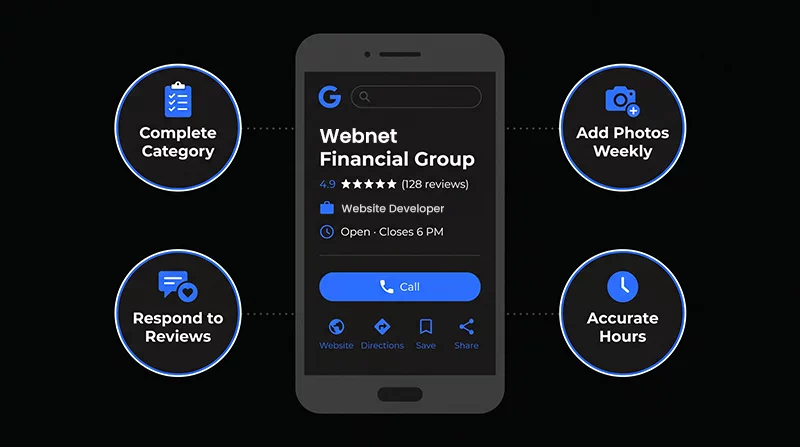
Every local SEO effort in India starts with the same foundation — your Google Business Profile, previously known as Google My Business. This is the free listing that appears in Google Maps and in the Local Pack when someone searches for a business like yours nearby, and for most small businesses, it matters more than the website itself when it comes to local visibility.
Setting it up correctly means more than just claiming the listing. The business category you select needs to match exactly what you do — a business selecting “Marketing Consultant” when it actually provides SEO services is reducing its own visibility for the searches that matter most, because Google uses this category as a primary signal for relevance. Your business name should be your actual business name, not a keyword-stuffed version — profiles with names like “Best Cheap Dentist Delhi No1 Clinic” violate Google’s guidelines directly and risk suspension rather than better rankings.
Beyond the basics, three ongoing habits separate profiles that actively rank from ones that quietly fade into irrelevance. Adding photos regularly — not just once during setup — signals an active, real business to both Google and potential customers. Posting weekly updates through Google’s built-in posting feature functions as free advertising space directly inside your listing and has been shown to meaningfully increase how often a business appears in top map results. And responding to every review, positive or negative, signals genuine engagement that Google’s local ranking systems account for.
How to Rank on Google Maps in India — What Actually Determines Position
Are you aware of Google’s local ranking system? Whether searched from Delhi, Mumbai, or even a smaller city, evaluates businesses on three core signals that work together rather than independently.
The relevance of your content or website measures how well your business profile matches what someone is searching for. This is why the category selection mentioned earlier carries so much weight, along with how clearly your business description and services list explain what you actually offer.
Distance accounts for how close your business is to the person searching, or to the location mentioned in their search. This one sits largely outside your control, though service-area businesses — consultants, agencies, home repair services — can still rank well across a wider area by correctly configuring their service area settings rather than relying on a single fixed address.
Prominence is where most of the controllable ranking opportunity lives, and it covers how well-known and trusted your business appears based on signals across the web — the volume and quality of your reviews, how complete your profile is, and how consistently your business information appears across other websites and directories. The last piece, referring to NAP consistency a firm’s Name, Address and Phone number matching exactly on every platform where your business is listed has a measurable effect on the ability to rank locally, and it is one of the elements most commonly ignored by Indian small businesses that manage their own listings.
For businesses in India specifically, getting listed accurately on platforms like JustDial, Sulekha, and IndiaMART alongside Google Business Profile reinforces this consistency signal and is worth treating as a standard part of the setup process, not an optional extra.
How to Get Google Reviews for Local Business — The Highest-Impact Factor
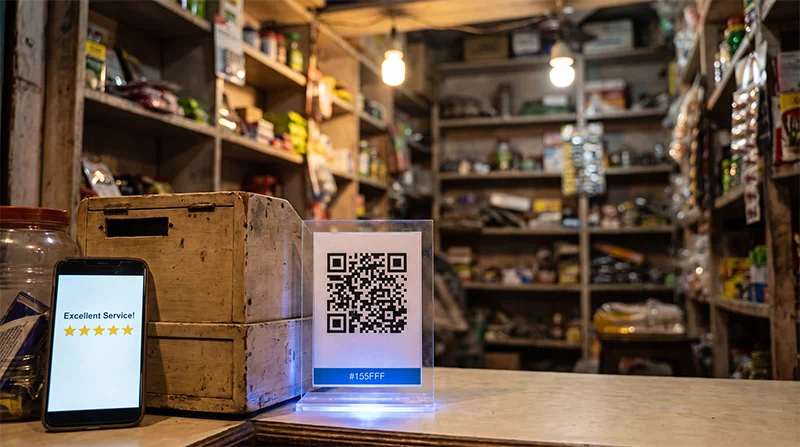
If there is one factor worth prioritizing above everything else in this guide, it is reviews. Google’s local ranking algorithm weighs review quantity, quality, recency, and relevance heavily, and the gap between businesses that actively manage this and those that do not is significant — businesses with fifty or more reviews and a strong average rating see a meaningfully higher chance of ranking in the top local positions compared to those with few or no reviews at all.
The practical challenge most small business owners face is not convincing customers to leave reviews reluctantly — it is simply never asking. The businesses that consistently build a strong review profile treat asking as a routine part of every transaction, not an occasional afterthought.
One thing that will definitely work for the way Indian businesses operate is that after a positive situation, they send a review request via WhatsApp within a couple of hours when the customer’s experience is still fresh in their mind. A brief text along with a clickable link that leads you straight to your Google review page is a good way to reduce the barriers the fewer steps a satisfied customer has to take before leaving a review, the more likely they are to complete it. Staff can be trained to make a brief mention of this at the time of a positive interaction, rather than completely relying on automated messages, and this is a well-established practice that yields superior results as it is accompanied by a personal, immediate context. Replying to each and every review is as important as gathering them. A well considered answer to a top-tier review reiterates the good time in a public way. A calm, professional response to a critical review often does more to build trust with future customers reading it than the negative review itself does to damage your reputation — prospective customers frequently judge a business more by how it handles criticism than by the fact that criticism exists at all.
Local SEO Checklist for Small Business — What to Do This Month
Turning everything covered so far into an actual monthly routine keeps local SEO from becoming another task that gets started once and forgotten:
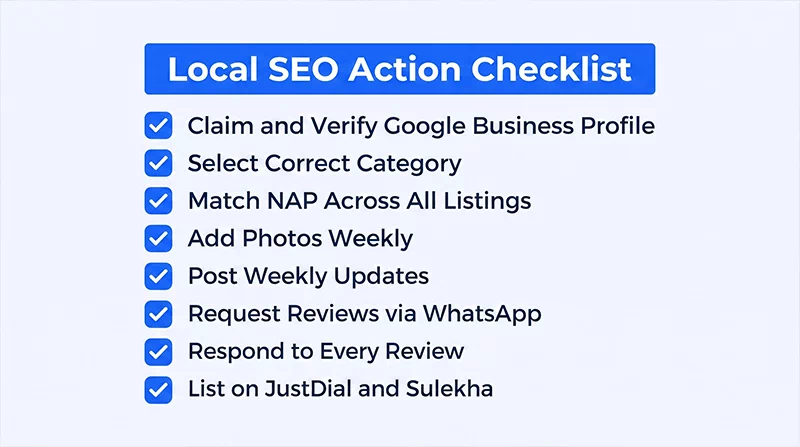
- Claim and fully verify your Google Business Profile if this has not already been done — this remains the single highest-impact starting action available to any local business
- Select the most accurate primary category for your business, and review it periodically as Google occasionally adds more specific category options
- Ensure your Name, Address, and Phone number match exactly across your website, Google Business Profile, and any directory listings — even small formatting differences can weaken this signal
- Add new photos regularly — of your space, your team, your products or work — rather than relying on photos uploaded once during initial setup
- Post a weekly update through Google’s built-in posting feature — an offer, a recent project, a seasonal update, anything that signals an active business
- Build a consistent review request habit — via WhatsApp or a simple printed QR code at your point of sale — rather than requesting reviews sporadically
- Respond to every single review within a few days, whether positive or negative
- Get listed accurately on Indian directories — JustDial, Sulekha, IndiaMART — with information matching your Google profile exactly
None of these individually require significant time, but together, maintained consistently, they compound into the kind of local visibility that keeps showing up month after month rather than producing a temporary spike.
Local SEO vs Regular SEO — Understanding the Difference
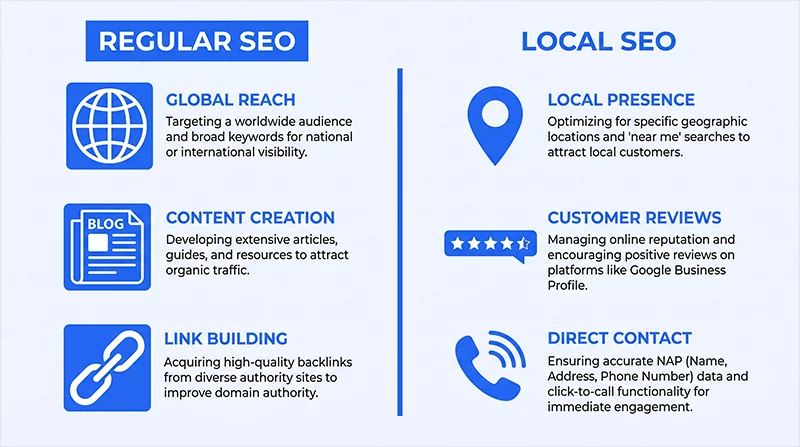
It is worth being clear about how local SEO differs from the broader SEO work most guides focus on, because the two require different priorities and often different timelines for results.
Regular SEO focuses on ranking a website for search terms regardless of the searcher’s location — useful for businesses selling products or services nationally, or for content-driven websites building broad topical authority. This is the kind of work covered in depth around the on-page SEO checklist fundamentals — meta titles, content structure, technical performance — and it typically takes several months to show meaningful movement for competitive terms.
Local SEO specifically targets visibility for people searching within a geographic area relevant to your business, and it operates on a noticeably faster timeline. Improvements to your Google Business Profile — adding missing information, gathering a batch of new reviews, correcting category selection — can show measurable ranking movement within weeks rather than months, because Google’s local ranking system reassesses these signals more frequently than it recrawls and re-evaluates broader website content.
For most small businesses in India serving a specific city or neighborhood, the practical answer is not choosing one over the other but sequencing them correctly — starting with Google Business Profile optimization for faster visibility, while a properly built website with on-page SEO fundamentals in place supports and reinforces that local presence over the longer term. Understanding how Google decides rankings more broadly helps clarify why both layers matter together rather than in isolation.
Final Thoughts — Local Visibility Is a Compounding Asset
The businesses that consistently show up when nearby customers search are rarely the biggest or the most expensive. They are the ones that treat their Google Business Profile as an active part of their business, not a one-time listing to set up and forget. Every review requested, every weekly post published, every piece of consistent business information reinforced across the web adds a small amount of trust that compounds over months into genuine, dependable local visibility.
For small businesses across India — clinics, salons, coaching centers, repair services, restaurants, and countless local service providers — this represents one of the most direct paths available from being invisible on Google to being the obvious first choice when someone nearby needs exactly what you offer.
If your business needs both a properly optimized local presence and a website built to support it — fast, mobile-friendly, and structured for search from the ground up — working with a professional WordPress developer who understands how local SEO and website performance work together gives your business the complete foundation needed to capture customers at the exact moment they are searching for you.
Frequently Asked Questions — Local SEO for Small Businesses India
How long does local SEO take to show results for a small business in India?
Local SEO typically shows measurable movement faster than broader SEO efforts — often within four to eight weeks when Google Business Profile optimization and a genuine review-building habit are both in place, compared to three to six months commonly needed for competitive website keyword rankings. The specific timeline depends on how competitive your local market is and how consistently the ongoing habits — reviews, posts, photo updates — are maintained rather than treated as a one-time setup task.
Do I need a website if I already have a Google Business Profile?
A strong Google Business Profile can generate meaningful local visibility on its own, particularly for businesses primarily seeking calls, direction requests, or walk-ins. However, a proper website still matters for building deeper trust, showcasing more detailed information than a profile allows, and supporting broader SEO efforts beyond local search. Most successful local businesses in India use both together — a strong Google Business Profile for immediate local visibility, paired with an affordable web design services in India approach that keeps costs reasonable while still delivering a website that reinforces credibility and captures customers who research further before deciding.
Can a business with multiple locations use local SEO effectively?
Yes, though it requires a separate, properly configured Google Business Profile for each individual location rather than a single profile attempting to cover multiple addresses — Google explicitly prohibits one profile representing multiple locations and will suspend duplicate listings created to work around this. Each location needs its own accurate address, phone number, and location-specific reviews, with consistent branding and information across all profiles to maintain the trust signals that support ranking.
What is the biggest mistake small businesses in India make with local SEO?
The most common and costly mistake is treating Google Business Profile setup as a one-time task rather than an ongoing responsibility. A profile created once and never updated again gradually loses relevance as Google’s local ranking system favors consistently active businesses. The second most common mistake is inconsistent business information across different platforms — a business phone number that differs between the website, Google profile, and a directory listing weakens the trust signal that Google uses to evaluate local prominence, even when each individual listing appears complete.
Is local SEO worth it for a service-based business without a physical storefront?
Yes, and this is an increasingly common setup for consultants, freelancers, agencies, and home-service providers across India. Google Business Profile supports a Service Area Business configuration specifically for this situation, allowing a business to appear in local search results for the areas it serves without publicly displaying a home or private office address. This makes local SEO accessible even for businesses that do not operate from a traditional storefront location.