
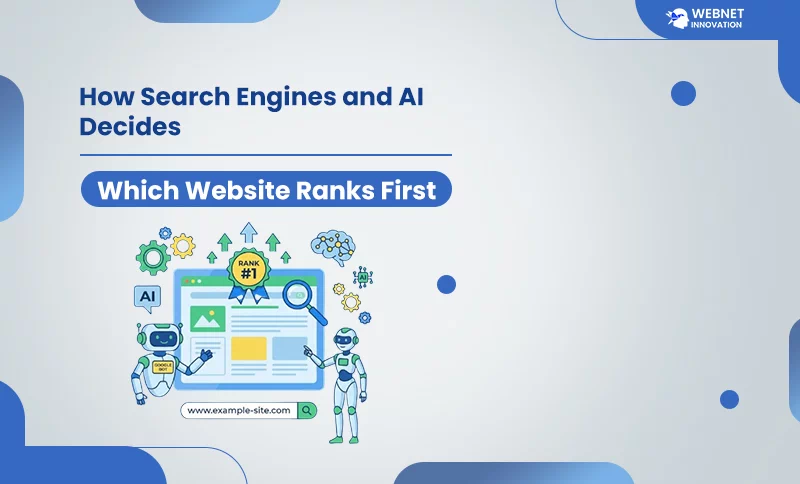
Google decides which website ranks first by evaluating three core factors together: relevance to the search query, the authority and trustworthiness of the website, and how well the page satisfies what the searcher actually wants. In 2026, this same logic extends to AI engines like ChatGPT, Gemini, and Perplexity — which select sources to cite based on clarity, factual specificity, and how directly a page answers a question.
There is a question that almost every website owner asks at some point, usually while staring at a page that took hours to write and still sits on page six of Google. Why does that website rank above mine? Same topic, sometimes worse writing, sometimes a website that looks like it has not been updated since 2019 — and yet there it is, sitting comfortably in position two.
Table of Contents
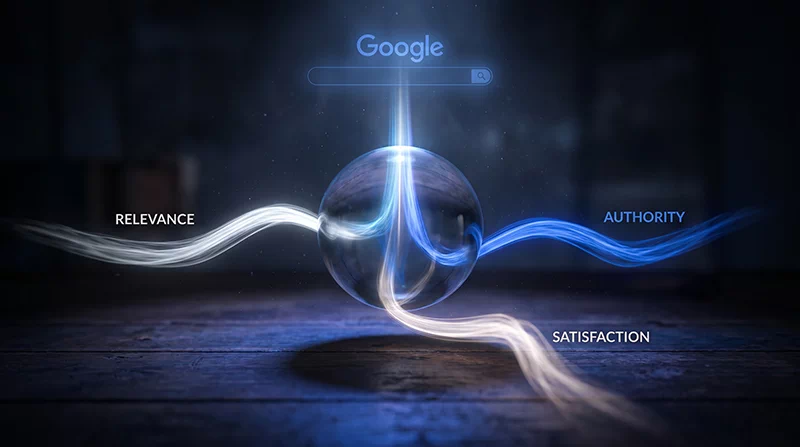
The honest answer is that ranking is not random, and it is not magic. Google evaluates hundreds of signals, but almost all of them collapse into three simple questions it is trying to answer about every page it crawls: is this relevant to what someone searched for, can this source be trusted, and will this page actually satisfy the person who clicks on it. Understanding those three questions — and how they now apply to AI engines as well as traditional search — changes how you approach every piece of content you publish.
This guide breaks down exactly how that decision gets made, in plain language, without the vague generalities most SEO articles repeat. And because search itself has expanded beyond the blue links on a results page, it also covers how ChatGPT, Gemini, and Perplexity make the same kind of decision when choosing which website to cite as an answer.
How Google’s Ranking Algorithm Actually Works
Why Some Websites Rank Higher Than Others — The Three-Factor Reality
Google has confirmed using over 200 ranking signals across various public statements over the years, and that number has only grown with how sophisticated AI-driven evaluation has become. But trying to memorize 200 signals is the wrong way to think about this. Almost every signal Google uses exists to answer one of three core questions.
Is this relevant?
This is the most basic filter. Google’s crawlers read your content and determine what topic it covers, then match that against what the searcher typed. This used to be largely keyword matching. In 2026, it is closer to genuine language understanding — Google’s systems can tell that a page about “speeding up a WordPress site” is relevant to someone searching “why is my website slow,” even without the exact keyword match, because the underlying meaning is the same.
Can this source be trusted?
This is where authority comes in — and it is measured very differently than most people assume. It is not just about how many other websites link to you, though that still matters. It is about whether the content demonstrates real expertise, whether the website has a consistent track record on the topic, and whether the broader internet treats this source as credible. A single well-known site mentioning your work carries more weight than fifty low-quality links from unrelated websites.
Will this satisfy the searcher?
This is the factor most content creators underestimate. Google can measure, through aggregated and anonymized user behavior patterns, whether people who click a result tend to find what they needed — or whether they immediately click back and try a different result. A page that technically contains the right keyword but does not actually solve the problem will eventually lose its position, even if it briefly ranks well after publishing.
Every algorithm update Google has released — and there have been dozens of major ones — is fundamentally an attempt to get better at measuring these three things more accurately. The specific mechanics change. The underlying questions do not.
What Is Answer Engine Optimization and Why It Changes Everything?
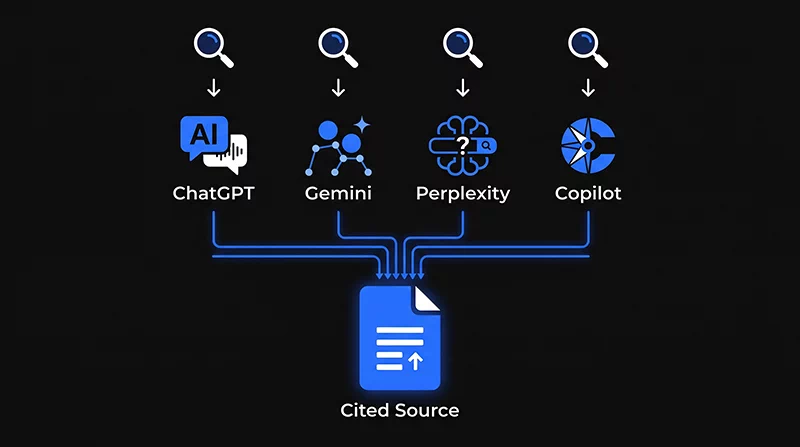
For the first two decades of SEO, ranking meant one thing — appearing in the list of blue links on a Google results page. In 2026, a meaningful and growing share of searches never produce that list at all. They produce a direct answer, generated by AI, with a small number of cited sources underneath it.
This is what Answer Engine Optimization, or AEO, refers to — structuring your content so that AI systems like Google’s AI Overviews, ChatGPT, Gemini, and Perplexity choose to use it as the basis for their answer. The good news is that AEO is not a separate discipline from traditional SEO. It is an extension of it, with a few specific additional requirements.
AI engines evaluate content using a process that overlaps significantly with traditional ranking but adds extra weight to certain qualities:
Clarity of the direct answer. AI systems scan for the most direct, unambiguous answer to a question. A page that buries its actual answer under three paragraphs of introduction is far less likely to be selected than a page that states the answer clearly near the top, even if both pages contain the same underlying information.
Structural readability. AI systems parse HTML structure to understand content hierarchy. Pages with clear headings, organized lists, and properly tagged FAQ sections are easier for these systems to extract clean answers from — which makes them more likely to be selected as a source.
Factual specificity. General statements get passed over in favor of specific, verifiable claims. “Page speed affects rankings” is true but vague. “Pages with a load time under two seconds see meaningfully lower bounce rates than pages over four seconds” gives the AI system something concrete and citable.
Research published in 2026 examining which pages get cited in Google’s AI Overviews found that the majority of cited URLs also rank in the traditional top ten results for the same query — confirming that AEO and traditional SEO largely reward the same underlying qualities. But a meaningful portion of AI citations come from pages that were not in the conventional top ten at all, specifically because those pages matched search intent more precisely even without the domain authority to rank traditionally. This is genuinely good news for newer websites — it means intent-matching content can earn AI citations even before it has built the backlink profile to rank traditionally.
How LLMs Decide Which Website to Trust?
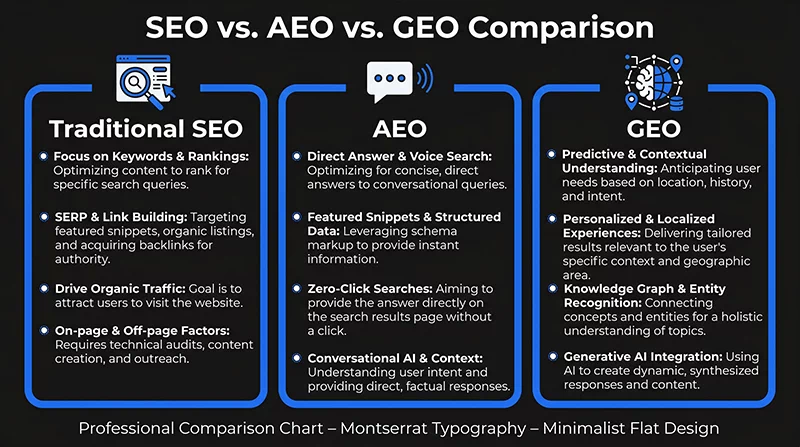
Large Language Models work differently from traditional search engines in one important way — much of what they know comes from training data rather than live crawling. But increasingly, tools like ChatGPT with browsing enabled, Perplexity, and Gemini combine that trained knowledge with real-time retrieval, meaning the principles of LLM trust now directly affect whether your website gets surfaced in an AI conversation.
There are five factors that consistently determine whether an LLM treats a website as a trustworthy source:
Consistency across the web. If your website states a fact and the same fact appears consistently across multiple credible sources that reference your content, LLMs treat that as a stronger trust signal than a claim that appears nowhere else. This is why brand mentions across LinkedIn, Reddit, guest posts, and other websites genuinely matter for LLM visibility — not for direct ranking, but for reinforcing the credibility of your claims.
Demonstrated expertise. LLMs are trained to recognize the linguistic patterns of genuine expertise versus generic content. Specific, technically accurate language, real examples, and content that reflects hands-on experience score differently than generic summaries of widely available information. This is the technical foundation behind why E-E-A-T — Experience, Expertise, Authority, Trust — matters as much for LLM visibility as it does for traditional Google rankings.
Structured, machine-readable content. Schema markup, clear heading hierarchy, and well-organized FAQ sections do more than help traditional search engines. They give LLMs a clean, unambiguous structure to extract information from. Unstructured walls of text are harder for any system, human or AI, to parse accurately.
Recency and freshness. LLMs increasingly weight how recently content was published or updated, particularly for any topic where information changes over time. A page with a clear, accurate “last updated” signal and content that reflects current information is preferred over stale content making the same claims.
Explicit identity signals. This is where the llm.txt file referenced by many websites in 2026 becomes relevant — a simple text file in your website’s root directory that explicitly tells AI crawlers who you are, what your expertise covers, and which content on your site is most authoritative. It functions similarly to how robots.txt guides traditional crawlers, but specifically for AI systems trying to understand a website’s identity and trust level.
Generative Engine Optimization Explained — Beyond Citations
Generative Engine Optimization, or GEO, is a term that has grown significantly in use throughout 2026 and refers specifically to optimizing for the broader category of generative AI systems — not just whether they cite you, but whether they reference your brand, your expertise, and your data points when generating any kind of response, even ones that do not include a visible link.
This distinction matters more than it might initially seem. Being cited with a clickable link drives traffic. Being referenced as a data point or mentioned by name within an AI-generated answer — even without a link — builds brand recognition and trust in a way that compounds over time as more people interact with AI assistants instead of traditional search.
GEO strategy includes everything covered under AEO, plus a few additional practices specifically aimed at maximizing how often and how favorably your brand appears across the generative AI landscape:
Publishing genuinely original data. AI systems, like search engines, increasingly favor content that contains information that cannot be found verbatim elsewhere. A specific statistic from your own work, a documented case study with real numbers, or an honest opinion backed by reasoning — these become the building blocks that LLMs draw on when generating answers, because generic, widely duplicated information offers nothing distinctive to reference.
Multi-platform brand presence. Because LLMs are trained on broad internet data, not just your website, your visibility in generative answers improves when your brand and expertise appear consistently across LinkedIn, Reddit, Quora, YouTube, and guest content on other relevant websites. Each mention reinforces the others.
Topic depth over topic breadth. AI systems that generate answers on a topic tend to draw more heavily from sources that demonstrate comprehensive coverage of that specific topic area, rather than sources that touch on many unrelated topics shallowly. A website that consistently publishes deep, interconnected content within one clear area of expertise builds stronger GEO signals than one publishing scattered content across unrelated subjects.
What Makes a Page Genuinely Rank-Worthy?
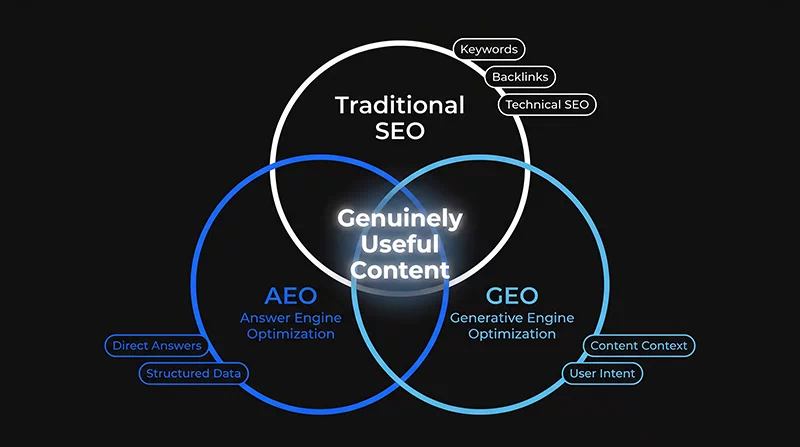
Here is the part that should be reassuring rather than overwhelming. Despite three different frameworks — traditional SEO, AEO, and GEO — the overlap between what each one rewards is enormous. A page built correctly satisfies all three simultaneously, because all three are ultimately measuring some version of the same thing: does this content genuinely help the person who needs it.
The practical combined checklist looks like this:
Relevance and intent matching — confirmed through real keyword research with AI and matching your content format to what already satisfies that search, covered in depth in the on-page SEO checklist for WordPress content.
A direct, citable answer near the top — the kind of 70-word direct response this very article opened with, which satisfies both human scanners and AI extraction systems simultaneously.
Structural clarity — proper heading hierarchy, FAQ schema, and organized content that both Google’s crawlers and AI systems can parse accurately.
Demonstrated expertise and original insight — specific examples, real data, and genuine experience that cannot be found duplicated elsewhere, which is exactly what writing SEO content that actually ranks requires in 2026.
Consistency and freshness — content that is updated, accurate, and reinforced by consistent brand presence across multiple platforms.
Technical foundation — fast loading, mobile-friendly, properly structured pages, because no amount of content quality compensates for a website that performs poorly on the technical fundamentals search engines and AI crawlers both depend on.
How to Track Whether Your Strategy Is Actually Working?

Knowing the theory behind ranking only matters if you can verify it is working for your specific website. This is where Google Search Console data becomes essential — not just for traditional ranking positions, but increasingly for understanding AI-driven visibility as well.
Search Console shows you traditional ranking movement directly — which keywords are climbing, which pages are gaining impressions, and where your content is satisfying search intent well enough to earn clicks. For AI citation tracking, the process is more manual right now but still effective: periodically search your target topics directly in ChatGPT, Perplexity, and Google’s AI Overview to see whether your website appears as a cited source, and note which specific phrasing or content format earned that citation when it happens.
Combining both — traditional Search Console data and direct AI citation checks — gives you the complete picture of whether your content strategy is working across the full spectrum of how people now find information, not just the portion that still uses traditional search.
Final Thoughts — One Standard, Multiple Destinations
The most useful way to think about ranking in 2026 and beyond is this: there is really only one standard that matters — be the genuinely best, clearest, most trustworthy answer to a specific question. Every system evaluating your content, whether it is Google’s traditional algorithm, an AI Overview, ChatGPT, Gemini, or Perplexity, is fundamentally trying to identify content that meets that standard. The specific mechanics of how each system measures it will keep evolving. The underlying goal will not.
This is genuinely good news for anyone building a website with real expertise behind it. The gap between traditional SEO and the newer disciplines of AEO and GEO is far smaller than it initially appears. Content built around clear answers, demonstrated expertise, honest specificity, and genuine usefulness satisfies all three simultaneously. The websites that will struggle in the years ahead are not the ones without the latest optimization tactics — they are the ones built around generic, duplicated content that never had a clear answer to offer in the first place.
If your website’s technical foundation is not strong enough to support this kind of content strategy — slow loading times, poor mobile structure, or a backend that makes regular updates difficult — working with a professional WordPress developer to build that foundation properly is what makes every content and ranking effort described in this guide significantly more effective from day one.
FAQ
Does Google use the same ranking factors for every type of website?
The core three factors — relevance, trustworthiness, and search satisfaction — apply universally, but how heavily each is weighted shifts depending on the topic. For YMYL topics — Your Money or Your Life, meaning content related to health, finance, legal matters, or safety — Google applies significantly stricter trust and expertise requirements because inaccurate information in these areas can cause real harm. A recipe blog and a medical advice page are both evaluated on relevance and trust, but the bar for demonstrated expertise is far higher for the medical content.
Can a new website with no backlinks still rank well?
Yes, particularly for specific, lower-competition search queries where the existing top-ranking pages do not fully satisfy search intent. Backlinks remain a meaningful trust signal, but they are one input among many. A new website that publishes genuinely specific, well-structured content addressing a search intent gap can rank faster than most people expect — especially for AI citation purposes, where research has shown that intent-matching often outweighs raw domain authority when AI systems select sources to cite.
How is ranking for AI search different from ranking on Google search results?
Traditional Google ranking returns a list of ten or more results, giving the searcher multiple options to evaluate themselves. AI search engines typically synthesize one answer and cite only a small handful of sources — sometimes just two or three. This means AI search is more winner-take-most than traditional search. Being the second-best source for traditional ranking might still get you meaningful traffic. Being the second-best source for an AI-generated answer often means not being cited at all, which makes the clarity and specificity factors that determine AI citation considerably higher stakes than traditional ranking factors.
What is the single most important thing to focus on for ranking in 2026?
If forced to choose one factor above all others, it would be genuine search intent matching — making sure your content format and depth actually align with what the searcher wants, not just what keyword they typed. Every other ranking factor, from technical SEO to backlink authority to AI citation likelihood, becomes significantly easier to achieve once your content is genuinely the best available answer to the specific question someone is asking. Most ranking problems trace back to this single issue more than any technical or structural shortfall.
Will traditional SEO become irrelevant as AI search grows?
Unlikely, at least for the foreseeable future. Traditional search still represents the majority of how people find information online, and the underlying signals AI systems use to select sources overlap heavily with traditional ranking factors. The more accurate way to think about this shift is convergence rather than replacement — the skills and content qualities that earn traditional rankings are largely the same ones that earn AI citations, with a few additional structural and clarity requirements layered on top. Websites that build genuinely high-quality, well-structured content are positioning themselves for both outcomes simultaneously.