
To write SEO content that ranks on Google Page 1 in 2026, start with keyword research to confirm real search demand, then match your content format to search intent. Structure your post with one clear H1, logical H2/H3 headings, and a direct answer in the first paragraph. Write for humans first — Google now uses AI to detect genuine helpfulness. Add FAQ sections, original examples, and update content every 90 days to maintain ranking position.
There is a moment every WordPress blog owner knows well. You spend three hours writing what feels like your best blog post — well-researched, properly formatted, keyword in the title. You hit publish, submit it for indexing, and then wait. Two months later it is sitting on page four with eleven impressions and zero clicks. Not because the writing was bad. But because ranking on Google in 2026 requires more than good writing — it requires writing that is built for both the human reading it and the algorithm evaluating it.
The frustrating part is that nobody tells you this clearly. Most SEO content guides are written by people repeating other guides — endless recycled advice about keyword density percentages and ideal word counts that stopped mattering three algorithm updates ago. This guide is different. Everything here is built around how Google actually works in 2026, what AI engines are looking for when they decide which content to surface, and what real WordPress websites are doing to consistently land on page one.
Table of Contents
What Has Changed About SEO Content Writing in 2026?
Before we get into the writing process, one thing needs to be understood clearly because it changes how you approach every sentence you write.
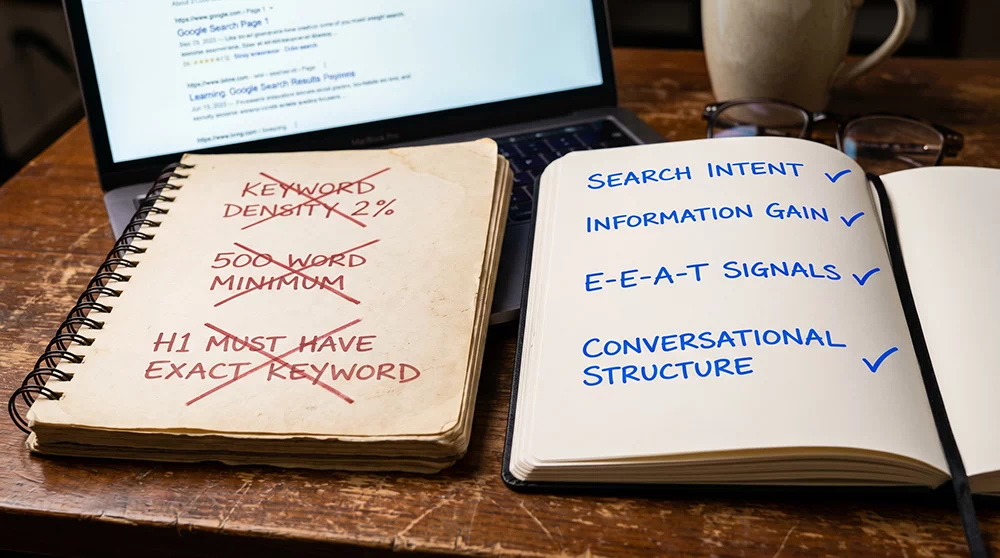
Google introduced something called the Helpful Content System — and it has been getting more sophisticated with every update. What it essentially does is try to detect whether a piece of content was written because someone genuinely wanted to help a reader understand something, or whether it was written primarily to appear in search results. The difference sounds subtle but it shows up clearly in how the writing reads.
Content written for rankings tends to awkwardly repeat the target keyword, add sections that don’t add value but look thorough, and use formal language that no real person would use in conversation. Content written for people tends to use natural phrasing, admit when something is complicated, use examples from real situations, and get to the point without unnecessary buildup.
In 2026, Google is getting very good at telling these two apart. The practical implication is that the fastest path to ranking is to write genuinely useful content — and then apply SEO structure on top of it. Not the other way around.
The second major change is the flood of AI-generated content across every niche. Because anyone can now generate a 2,000-word article in sixty seconds, the internet is full of structurally correct, factually average content about every possible topic. Google’s response has been to increasingly reward content with original insight — specific examples, first-person experience, data points that cannot be found verbatim elsewhere, honest opinions that contradict the consensus when there is a good reason to. That is what Information Gain means in practice, and it is the single biggest differentiator between content that ranks and content that drowns.
Step 1: Confirm Real Demand Before Writing Anything
“SEO Content Writing for WordPress — Start With Data, Not Inspiration“
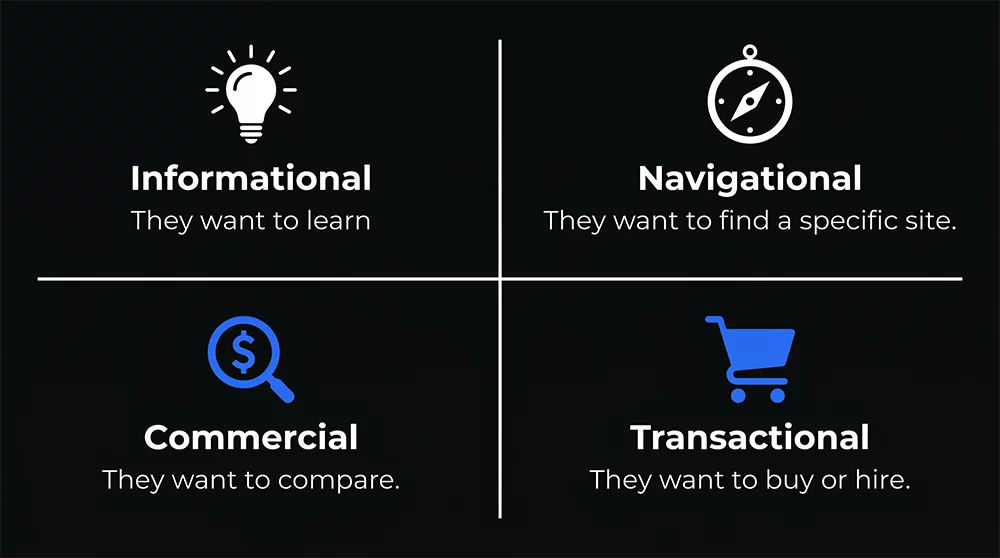
The single most common reason WordPress blog posts never rank is that they were written about topics nobody was searching for. Not because the topic was uninteresting — but because the writer assumed demand rather than confirming it.
Before writing a single word, confirm that real people are actually searching for what you plan to write. This does not need to be a complicated process. Check your keyword research findings — if you have done proper AI-backed keyword research before writing, you already have a confirmed list. If not, three quick checks take under ten minutes:
Open Google and type your intended topic in the search bar. Look at the autocomplete suggestions — these are real searches people have made recently. If your topic does not appear in autocomplete, you are working in very low demand territory. Check the “People Also Ask” box on the results page — every question there is a confirmed search query you can address within your post. And open your Google Search Console performance report to see if your domain is already getting impressions for related terms — if it is, you have a built-in advantage because Google already associates your website with that topic.
One thing I have learned from reviewing dozens of underperforming WordPress blogs: the posts that never rank are almost always the ones where the writer was enthusiastic about the topic but skipped this confirmation step. Enthusiasm and demand are not the same thing.
Step 2: Understand What the Searcher Actually Wants
“Content Writing Strategy for Google Page 1 — Intent Is Everything“
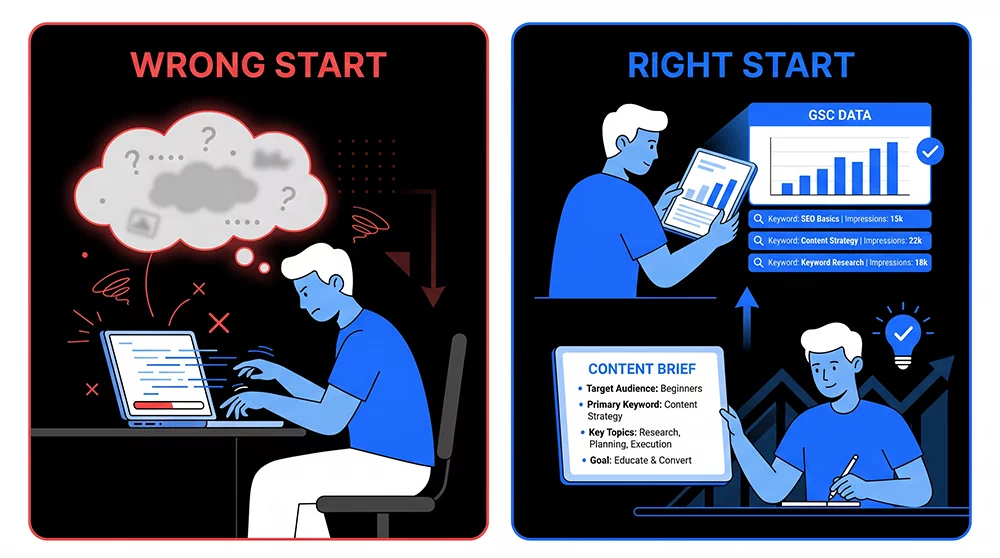
Open an incognito window and search your target keyword. Spend two minutes looking at the top three results — not reading them, just observing. Are they listicles, step-by-step guides, comparison articles, tool roundups, or beginner tutorials? Whatever format dominates the top results is what Google has decided searchers want for that query. Your content needs to match that format.
A real example that illustrates why this matters: if someone searches how to write SEO content, they want a process — specific steps they can follow today. If your response to that search is a philosophical discussion about the importance of good writing, you have misread the intent completely. The writing might be excellent. The format is wrong. Google will rank the step-by-step guide above the philosophical piece every time because steps match what the searcher came for.
Step 3: Write a First Paragraph That Earns the Reader’s Trust
“What Makes Content Rank on Google — The Opening That Hooks and Holds“
Most blog posts lose their reader in the first paragraph. Not because the opening is badly written — but because it does not acknowledge the reader’s specific situation. Generic openings like “In this article, we will explore…” or “SEO is very important for your website because…” tell the reader nothing about whether this particular post is the right one for their specific problem.
Your first paragraph has one job: make the reader feel that you understand exactly why they searched for this and that you have something specific and useful to say about it. That requires acknowledging the problem before you offer the solution.
For a post about SEO content writing, the opening might start by describing the exact frustration the reader has experienced — publishing content that never ranks, wondering what went wrong — before moving to the promise of what this guide will show them. When a reader sees their own situation described accurately, they lean in. That engagement signal — time on page, scroll depth — feeds directly into how Google evaluates whether your content is satisfying the search intent.
The other thing the first paragraph must do in 2026 is answer the main question immediately for AEO purposes. Google AI Overviews and AI engines like ChatGPT pull answers from the earliest clear, direct response in your content. This is why this guide opens with a 70-word direct answer before the introduction — not because it makes the writing easier, but because it is what gets your content cited when someone asks an AI assistant the same question.
Step 4: Structure Your Post for Both Humans and Search Engines

“How to Structure a Blog Post for SEO — The Framework That Works“
Structure is where most good writers make their on-page SEO checklist. They organize their post the way they would write an essay — building an argument that arrives at a conclusion. That is excellent writing structure and poor content structure for search.
Search-optimized content structure works differently. The most important answer comes first. Subtopics are arranged by what readers are most likely to want, not by what builds the best narrative arc. Each heading is written as a complete thought that makes sense on its own — because featured snippets and AI engines often pull headings without the surrounding context.
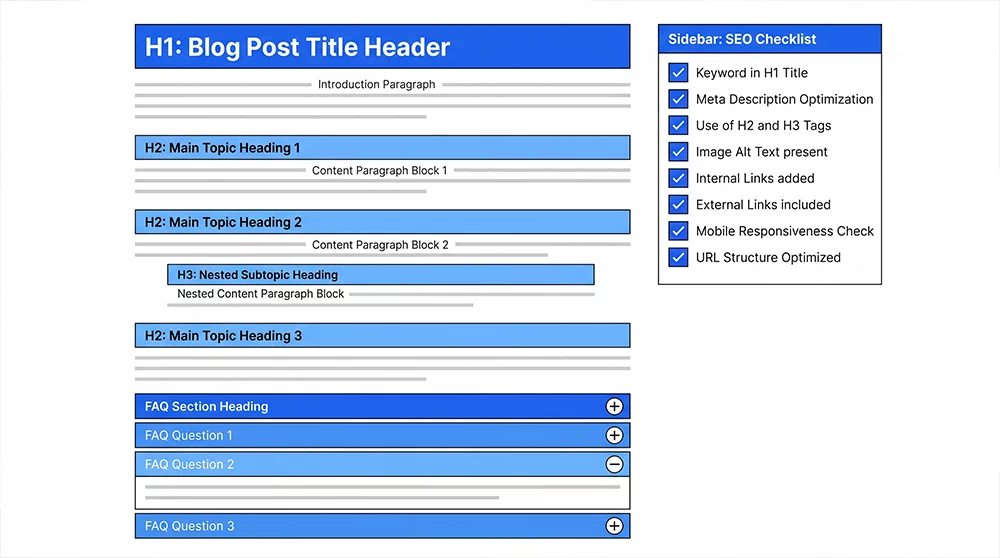
Here is the structure that works consistently for WordPress blogs targeting Google Page 1 in 2026:
H1 — One per page, primary keyword included, written for click appeal
This is your title. It should contain your primary keyword in a way that feels natural and give the reader a clear reason to stay. “How to Write SEO Content” is a fine keyword. “How to Write SEO Content That Ranks on Google Page 1 in 2026” is a heading that contains the keyword and tells the reader specifically what they will achieve.
H2 — Main sections, secondary keywords, written as standalone value
Each H2 should be a specific subtopic or question your target reader would want answered. Write them as questions or clear statements — not vague category labels. “Benefits of SEO Content” is a vague H2. “What Makes Content Actually Rank on Google in 2026” is an H2 that could function as its own search query and tells the reader exactly what that section delivers.
H3 — Supporting points within H2 sections
Use H3 for specific techniques, examples, or subsections within a larger H2 topic. Do not create H3s just to add visual variety — every H3 should represent a genuinely distinct point that deserves its own space.
First 100 words of each section — make them earn their place
Readers and AI engines scan headings first, then read the opening sentence of each section to decide whether to continue. The first sentence of every section should deliver immediate value — not ease into the topic gradually.
This structure also maps perfectly to the on-page SEO checklist items for WordPress — heading hierarchy, keyword placement in subheadings, and section-level intent matching are all technical SEO elements that this writing structure naturally satisfies.
Step 5: Write Content That Has Information No One Else Has
“Writing SEO Optimized Blog Posts — The Originality Factor“
This is the hardest part to teach because it cannot be templated — and it is the part that matters more in 2026 than it ever has before.
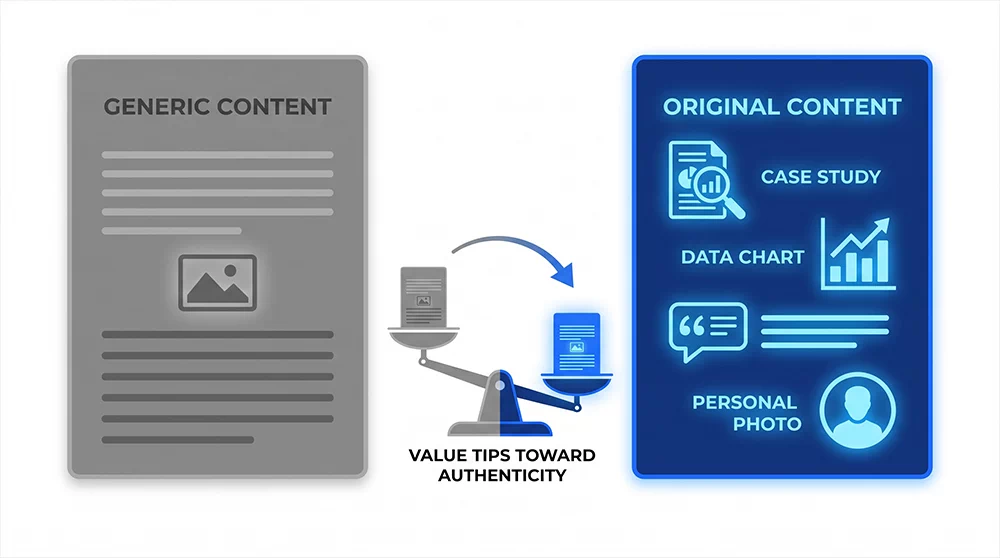
Information Gain is what Google calls the measure of how much new, useful information your content adds compared to what already exists on the same topic. Content that scores low on this metric — meaning it mostly repeats information found elsewhere — is being actively suppressed in rankings. Not penalized, but not rewarded either. It simply does not surface consistently because Google has better options to show.
What counts as original information in a WordPress development and design blog:
A specific project example. “One of my clients had a WooCommerce store with 47 products. After switching to a lightweight theme and removing six unused plugins, their LCP dropped from 6.2 seconds to 1.8 seconds. Their conversion rate went up 34% in the following month.” That is one specific example that contains more ranking power than five paragraphs of general advice about page speed, because no other page on the internet has that exact information.
A real mistake you made. Describing something that went wrong on a project, what you tried, what did not work, and what eventually fixed it is inherently original content because it comes from direct experience. Readers find it more useful than perfect advice because it is honest, and AI engines are increasingly trained to value authentic experience signals.
An honest opinion that contradicts common advice. If you genuinely believe that most WordPress plugin recommendations are outdated and that the plugins recommended by major blogs are chosen for affiliate commission rather than performance — say that, with your reasoning. Differentiated opinions are information gain by definition because nobody else has said exactly that.
Step 6: Write for AI Search and Voice — The 2026 Requirement
How to Write Content for AI Search in 2026
The way people search is changing faster than most content strategies are adapting. In 2026, a significant portion of searches happen through AI assistants — ChatGPT, Gemini, Perplexity, Siri, Copilot — rather than typed into a search bar. These searches are conversational. They are longer, more specific, and phrased as complete questions rather than keyword fragments.
Writing content that gets cited in AI answers requires a specific approach that is slightly different from writing for traditional search:
Direct question-answer pairs throughout the content
Every H2 or H3 heading that is phrased as a question should be immediately followed by a direct answer — not a buildup to an answer. The AI engine does not wait for your three-paragraph preamble. It reads the heading, finds the first clear sentence after it, and either cites it or moves to the next source. Your first sentence after every question heading is your citation opportunity.
Conversational language in technical sections
AI voice answers are read aloud. If your content is full of sentences like “leveraging synergistic content strategies” or “optimizing multi-channel engagement frameworks,” an AI assistant cannot read that naturally to a human listening through earphones. Write the way you would explain something to a client over a video call — the sentence structure that sounds natural when spoken aloud also performs better in AI-generated answers.
Specific, citable facts in every section
AI engines prefer citing sources that contain specific, verifiable information. “Page speed is important for SEO” is not citable. “Pages that load in under 2 seconds have 15% lower bounce rates than pages loading in 4 seconds” is citable — it is specific, verifiable, and directly useful to the reader. Every section of your content should contain at least one fact or data point this specific. These are the sentences AI engines pull when answering questions in your niche.
Step 7: Track What Happens After You Publish
SEO Blog Writing Tips — What Most Writers Skip After Publishing
Publishing is not the finish line. For most blog posts, the version that eventually ranks is the third or fourth revision — not the original publication. The content that ranks in competitive niches has been improved based on real performance data, not published and forgotten.
The tracking habit that produces results: fourteen days after publishing, open your Google Search Console and look at the page in the URL Inspection tool. Note what keywords it is appearing for — there will almost always be keyword variations you did not plan for. Some of them will have higher search volume than your target keyword. Add sections addressing those unplanned keywords to the post, request reindexing, and check again in another fourteen days.
This iterative approach — publishing, tracking, improving — is how single blog posts go from page four to page one over a series of months. The initial publication gets Google’s attention. The improvements earn the ranking. Almost every post that consistently holds a top-three position has been improved at least twice after its initial publication.
The AI SEO tools covered in this guide’s companion resources can automate much of this tracking and improvement analysis — feeding your Search Console data into AI to get a specific list of what each post needs to move up is now a standard part of managing a content strategy rather than an advanced tactic.
Final Thoughts — The Best SEO Content Is Written Twice
The first time you write a piece of content, you are figuring out what you know about the topic. The second time — when you revise based on real performance data — is when you figure out what your specific audience needed from it. The posts that hold Page 1 positions consistently are almost always the ones that have been through that second writing.
Start publishing. Track what happens. Improve what the data shows needs improving. Repeat. That cycle, applied to every piece of content on your WordPress site, compounds into the kind of topical authority that Google rewards with consistent rankings.
If the foundation your content sits on — the WordPress setup, the page speed, the technical structure — is not performing at the level your content deserves, a professional WordPress developer who understands how technical performance and content strategy connect will make every word you write more effective. Strong content on a fast, well-structured site outranks strong content on a slow one every single time — because website speed affects rankings in ways that compound with every positive content signal you build.
FAQ
How long should an SEO blog post be in 2026?
The honest answer is: as long as it needs to be to fully cover the topic better than the pages currently ranking for your target keyword. Check the word counts of the top three ranking pages for your keyword and use that as your baseline — not a universal minimum. Some competitive topics need 3,000 words to rank. Others are fully covered in 900. Adding unnecessary sections to hit a word count does not help rankings in 2026. Google evaluates whether each paragraph adds value. Padding that does not add value is detected and discounted. Write until the topic is fully covered, then stop.
Should I use AI to write my SEO blog posts?
AI is a strong tool for research, outlining, and drafting — but the content that ranks in 2026 consistently includes original experience, specific examples, and genuine opinions that AI cannot generate from scratch. The approach that works is using AI to build the structure and fill in standard sections, then writing the parts that require real experience yourself — the examples, the case studies, the honest evaluations. Content that is 100% AI-generated reads as such even when it is technically accurate, and Google’s Helpful Content System is increasingly good at identifying it. The hybrid approach gives you the efficiency of AI with the authenticity that ranking requires.
How do I make my blog post rank faster after publishing?
Three things consistently speed up ranking. First, submit the URL immediately in Google Search Console URL Inspection and click Request Indexing — this gets Google to crawl your page within hours rather than days. Second, add internal links to the new post from two or three of your existing high-performing pages — this passes authority to the new post and helps Google find it faster. Third, share the post on LinkedIn and Reddit in communities where your target audience is active — social engagement signals are not a ranking factor directly, but the traffic and dwell time they generate feed positive signals to Google’s quality assessment.
How many times should I use my keyword in the blog post?
There is no specific count that is correct — there is only a natural density that reads well. For a 2,000-word post, your primary keyword appearing four to six times naturally is appropriate. That includes the title, the first paragraph, two or three subheadings, and a mention in the conclusion. What kills rankings is repeating the exact keyword phrase awkwardly when a natural variation would work better. “How to write SEO content” and “writing content that ranks on Google” and “SEO-optimized blog writing” all signal the same topic to Google. You do not need to repeat the exact phrase every time — semantic variations count.
Why does my blog have impressions but no clicks?
Almost always a meta title problem. If Google is showing your page — meaning you have impressions — but people are not clicking, your title is not winning the competition against the other results on that page. Read your title the way a searcher would: does it clearly promise what they came to find? Does it give them a reason to choose yours over the result above or below it? Does it match the search intent — is it a guide when they want a list, or a comparison when they want a tutorial? Fixing the meta title and meta description of high-impression, low-click pages is the single fastest SEO win available in your Search Console data.
Does updating old blog posts help SEO?
Yes — significantly, and faster than most people expect. Google treats updated content as freshly relevant, which means it recrawls the page and re-evaluates its ranking potential. Pages that have been stagnant for six months or more often see ranking improvement within two to three weeks of a meaningful content refresh. Meaningful means adding new information, updating year references, strengthening weak sections, and improving the meta title and description. Running your existing posts through the on-page SEO checklist before creating new content is often more efficient — improving what already exists tends to produce faster ranking gains than building new authority from scratch.